
We monitor Key Metrics to Improve Results

Get Started Log In

Do You Know Your Business’ Geographic Market?

Do You Know Your Business’ Geographic Market?

For the majority of companies, there is a variety of factors that determine whether a customer will work with you or not. Many of those factors you can control, like the quality of your products, availability of inventory, and customer service, but there are some factors that aren’t in your control. One of those factors is your company’s geographic market.

What is geographic market?

Your business’ geographic market measures the number of miles that customers are willing to travel in order to work with you. If you’re beyond that maximum distance, then that customer is extremely unlikely to do business with you. The geographic market for any particular business will vary within different industries, markets, and regions. However, the majority of companies, especially brick and mortar ones, have a specific geographic market.

To learn what your business’ geographic market is, you have to understand where your customers are coming from. Once you know where they are coming from, you can discover patterns and see whether distance is a factor and how important of a factor it is for developing your customer base.

Why geographic market matters for your business

If distance is an important factor for your company, it will be difficult or impossible to keep customers who are beyond that range. For example, the majority of heavy equipment dealers have a service area with a 60 mile radius at the most. The reason for this maximum distance is that beyond that range the dealer won’t be able to travel quickly enough to a customer who requires emergency equipment service.

When you struggle to gain and retain customers beyond a specific range or outside of a particular geographic market, it’s not worth trying to sell your products and services to customers who aren’t located in that market. You’ll be spinning your wheels and wasting your marketing resources on them. For that reason, it’s crucial to understand how far the reach is for your specific business.

Use your geographic market to focus your strategy

Although distance from a customer is not something you can typically control, you can use the knowledge of who is more likely to work with you than others to your advantage. By understanding your geographic market, you can focus your marketing within that range and only target prospects who have a lot more potential for your business. In the long run, this targeting will save you money, help you tailor your marketing and sales messaging, and become highly skilled at serving the customers in your specific area. All of these things are conducive to long term growth.

To understand your company’s geographic market, it’s important to conduct a Zintoro market analysis of potential customers to determine how large your potential market is and exactly what the distance is for your maximum reach. This analysis will help guide your business strategy and keep you from wasting resources.

What is your geographic market? Do you know how to identify prospects within that market, so you can convert them to customers?

Get help identifying who your best target customers are.

Contact Zintoro for a market analysis today!

Achieve Your Revenue Goals: The First Step Is Understanding Where You Are Now

Revenue and transaction trends identify your company’s sales patterns over the prior twelve month period. Recognizing these patterns and what activities lead to growth is a critical step in making the right decisions for your company. Understanding your company’s revenue analytics and trends will help you answer the following key questions

  • Who should you target for marketing initiatives? 
  • Which products or services should you focus on?
  • What customer and prospects should your salespeople spend time contacting?

How to meet your revenue goals

Trends for transactions and customer retention are the primary drivers of revenue, because they explain exactly what is happening in your business. They also tell you where your sales team and marketing efforts should focus to engage your customers and keep them coming back consistently.

Here’s an example. For one company, new customers during the past 12 months make up 51% of their customers. Here’s how these customers evolve over time, if they keep buying from the company:

Average transactions

Year 1: 3

Year 2: 13

Year 3: 18

Average revenue

Year 1: $39,099

Year 2: $154,537

Year 3: $178,789

What these revenue analytics show is that customers purchase more from you and are more valuable to you the longer they work with you. For this reason, retaining new customers over the long term has a huge impact on meeting your revenue goals.

Take advantage of revenue trends

For most companies, each year they keep a customer buying from them, that customer increases the number of purchases and how much they spend. One of the most critical aspects of reaching your revenue goals consistently is to ensure customer retention. Below are some strategies for retaining your customers:

  • Consistent engagement – Send several targeted emails every month to your customers, reminding them of the products and services you offer, establishing yourself as an expert in your field, and encouraging them to purchase.
  • Targeted approach – Look at your customer purchase data to anticipate what they may need or when they might be getting low on a product. Then send out an email or make a sales call that is specific to that customer’s needs.
  • Collect and respond to feedback – Implement customer satisfaction surveys to gain insights into how customers feel about your company and how well you provide for their needs. You’ll learn about issues and problems and have the chance to solve them before a customer leaves you. Effective customer satisfaction surveys can boost retention by 20% – 30%.

Stay on top of your customers with emails, sales calls, and surveys to ensure they continue working with you and that you reach and exceed your revenue goals.

Understand your revenue analytics with Zintoro

By knowing which customer segments and which products produce the most value for your company, you can better target your sales team and marketing efforts. Focus on retaining your current customers, and highlight the products that generate the most revenue. That means that your sales people should be reaching out to at risk customers, encouraging them to stay, and your marketing people should be putting the most resources behind your frequently bought products and services. Zintoro’s analytics portal shows you exactly which customers should be called when and which products should be promoted.

If you want to understand your revenue analytics and implement tried and proven strategies to exceed your revenue goals, contact Zintoro today for a demo.

What Is an Industry Analysis and Why Your Business Needs One

As a business, you want to reach and sell to as many customers as possible. The problem is that it takes resources to connect with prospects and potential customers. Your company only has a limited amount of those resources, which means you have to make decisions about who to target with your marketing and sales efforts, because you can’t target everyone.

The key is to go after those people who are most likely to work with you, and who have the potential to produce the most value for your business. That’s where an industry analysis comes in.

What is an industry analysis? The basics

At Zintoro, we conduct your industry analysis by looking at Standard Industrial Classification (SIC) codes that are represented in your company’s existing customer list. SIC codes essentially tell you which industry a particular company is in. By analyzing the customer count, sales volume, revenue, number of potential customers, and other metrics for every industry SIC code in your list, you can understand the market potential for each segment of your customer base.

Knowing which segments of your existing and potential customers produce the most value for your company will help you recognize which industries have the best revenue potential. Armed with this information, you’ll understand how much value different customers and segments of customers can produce for your company, which can inform your decisions on which new prospects to target. You can then focus your time and resources on increasing your market share in the industries with the most potential.

How to take advantage of an industry analysis

In order to gain the most value from an industry analysis, you have to understand which industries are represented in your current customer list and how valuable each of those industries is to your company. This analysis will determine your marketing strategy and help you place your resources where they are most likely to benefit your business.

Once you know which industries you should be targeting, you can then tailor your sales and marketing messaging to match those industries. For example, if you sell excavators and find out that the majority of your current customers exclusively handle demolition jobs, then you can target more demolition companies by highlighting the aspects of your products that are most useful to them.

By focusing on your company’s target industries, you’ll waste fewer resources and be much more successful in growing your customer base and increasing sales.

Want to better understand your customer base and achieve stronger growth? Contact Zintoro for an industry analysis today!

Know the Types of Purchases Your Customers Are Making

Business analytics reporting is crucial for gaining a better understanding of your business and your customers. One of the most important key metrics that we measure is called types of purchases. By analyzing what your customers are buying, we can determine which products they purchase most frequently, how often they buy them, and how your different branches or departments compare on sales of specific products.

Why types of purchases matter for your business

A successful business has to connect customers and potential customers with the products and services that they want and need to buy. By identifying which products you sell in the greatest quantities, you’re better able to focus your marketing and advertising strategies and make the most out of your limited resources and budget.

Products or services that are normally purchased more often will deliver a greater ROI for your marketing campaigns than less popular products would. People want to buy them; all they are waiting for is you to put the product in front of them to remind them to do so. Being aware of your customers’ most common types of purchases will help you avoid wasting money on advertising too much for products that are less popular and that yield a smaller ROI.

How to take advantage of knowing types of purchases

Once you determine your most frequently bought products, you gain a fuller picture of your business and what steps you should take to achieve growth.

Know where to place resources

By understanding types of purchases, you will know which things to run promos on, which products to have front and center in your emails and on your website, and which products to focus on for any paid advertising. This metric will also tell you which products and services you should post most frequently about on social media.

Gain insights for product development

You can use types of purchases to know what new products to develop. Leverage the knowledge of what sells the best to help create similar or complimentary products that are likely to sell equally as well.

Introduce customers to more products

Using your knowledge of customer purchases, you can introduce them to additional things you offer. They will open your email, click on your ad, or come to your website for the more popular product that serves as the hook, but then they’ll see the other ones that you also have featured.

Improve specific departments

Knowing the types of purchases your customers make will help you understand your own business better. For example, you will be able to see which branches or departments sell more or less of specific products or services. If a product is selling great at every other branch but one, then there may be an issue specific to that branch.

At Zintoro, we’ll provide you with monthly business analytics reporting so you can understand key metrics like types of purchases, purchase frequency, customer retention, and many others. Then, our partner company Winsby can help you implement email, website, survey, and other marketing strategies to improve them all across the board.

How to Reach Your Revenue Goals

Almost every business sets revenue goals for the year. Most will check their progress towards those goals by looking at how much revenue they’ve brought in to date and then comparing to previous years. But what a lot of businesses don’t do or don’t know how to do is look at why their revenue is trending up or down. That’s a problem because, unless you understand the “why”, you won’t know what to do to improve it.

Which business metrics matter

In order to understand your progress toward revenue goals, two of the most important business metrics or analytics to look at are customer retention and purchase frequency. Customer retention measures the percentage of customers that purchased within the last 12 months that also purchased within the prior 12 months. Purchase frequency tracks the number of times a customer buys products or services from a company within a given period.

Customer retention

Customer retention is key to reaching your revenue goals, because your customers spend more every year that they do business with you: 30% more in year two and another 50% more in year three. The longer you retain your customers, the greater their spend will be and the higher your revenue will be. In fact, increasing customer retention by just 5% can boost profits by 25% to 95%.

Purchase frequency

Purchase frequency is just as important as customer retention. If a customer’s purchase frequency is decreasing, then you are at risk of losing them. If their purchase frequency is remaining steady or increasing, then you have a better chance of retaining them over the long term. A higher purchase frequency can also mean a higher customer spend, moving you closer towards your revenue goals.

Improve customer retention and purchase frequency to reach your revenue goals

Increasing retention and purchase frequency is crucial for boosting the amount of money you bring in. Winsby has tried and proven methods for expanding both.

Customer retention

The simplest method for improving retention is to find out why customers are leaving. The best way to do that is through customer satisfaction surveys conducted by an outside third party like Winsby. Using a third party will elicit candid comments that customers may not want to share with an employee of your company, and the surveys will provide specific feedback, so you can solve any issues quickly.

We see an increase in retention rates of 20% or more when customers are routinely surveyed about their experience with a company in Winsby’s customer satisfaction surveys.

Purchase frequency

Distributing emails to customers and prospects increases how often customers purchase from you and remind customers of everything you offer. In fact, with Winsby’s emails, customers on your distribution list will generally purchase two to three times more often than customers who are not receiving the emails.

Understanding your business metrics

Before you can improve key business metrics like retention, purchase frequency, and others, you have to start measuring analytics, know how they trend, and understand what those trends mean for your company. When you work with Zintoro and Winsby, you have a portal where you can view all the most important business metrics. Our financial experts will walk you through them, provide insights on trends, and help you make better decisions for your company.

Business metrics available through your portal:

  • Historical customer retention rate
  • Net growth rate for number of accounts
  • The number of active accounts
  • How often customers purchase
  • Top customers
  • When customers purchased last & who hasn’t purchased recently
  • New customers
  • Lost customers
  • Historical revenue
  • Growth in the number of invoices

If you want to start measuring analytics, stay on track for your 2023 revenue goals, and set achievable revenue goals for 2024, reach out to our team today!

Understand the metrics that matter

Measuring Customer Retention – What a 91% Retention Rate Really Means

A business’ retention measures the percentage of customers that purchased within the last 12 months that also purchased within the prior 12 months. It is one of the most critical metrics to measure for any company. If you don’t have a solid business retention, then customers aren’t committed to working with you over the long term, and you must consistently devote time, money, and resources to find new customers.

Why long term business retention is so important

Long term retention is critical for the profitability of your business. As an example, for heavy equipment dealers, the revenue that each customer generates skyrockets when they move from year two to year three as a customer for a dealer. Customers purchase 2.9X more equipment, 9.1X more rentals, 4.1X more service, and 5.6X more parts in the third year as a customer, compared to the second year.

What that means is the longer a customer works with you, the more valuable they become for your business. Plus, losing the income from an existing customer is >10 times the value of a new customer. It will take 3 to 5 years to replace the income produced from an existing customer with income from a new customer. That makes it extremely important to hold on to your current customers.

This metric is crucial for profitability in both the short and long term. The question is, how do you go about measuring customer retention?

Measuring customer retention for your business

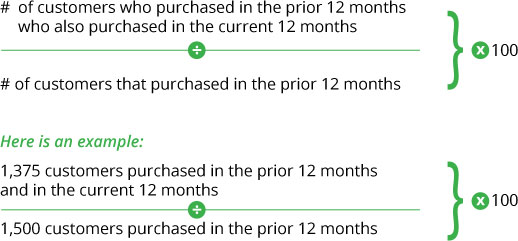
Measuring customer retention means looking at how many of your purchases came from existing and new customers over the past 12 months. Here’s how it is calculated:

Measuring customer retention using the above numbers would give you a rate of 91.7%.

What a 91.7% business retention rate really means

Although a customer retention rate of 91.7% may sound great, what it actually indicates is that you’re losing 8.3% of your customers each and every month. Losing 8.3% every month equals a turnover in customers of nearly 100% in one year. That’s your entire existing customer base!

How to improve your business retention

The simplest method for improving retention is to find out why customers are leaving. The best way to do that is through customer satisfaction surveys conducted by an outside third party. Using a third party will elicit candid comments that customers may not want to share with an employee of your company, and the surveys will provide specific feedback, so you can solve any issues quickly.

We recommend using Winsby to handle your customer satisfaction surveys. When they conduct surveys, we see an average increase in retention rates of 20% or more. They will work with you to develop an effective script, call your customers, find out any details related to negative responses, and share the survey results with you in real time. You’ll be able to solve issues fast, and your business will grow without any impediments!

Click here for more details on Winsby customer satisfaction surveys.

If you have any questions about measuring customer retention or conducting customer satisfaction surveys to improve it, contact our team today!